
The tin whistle solo at the end of "Home For A Rest" by Spirit of the West is one of the most recognizable instrumental moments in Canadian rock. It's a minute-long torrent of notes played by Geoffrey Kelly on a tin whistle (also called a penny whistle), a six-hole flute with no keys, built on three traditional Irish reels that are centuries old. I wanted to learn it on guitar.
The problem: no guitar tab existed for it. It was written for tin whistle, and the ornamentation that gives it its character, those rapid fluttering grace notes that make Kelly's playing dance, doesn't translate to guitar in any obvious way. At full speed, the fast passages are a blur of sixteenth-note triplets at 133 BPM. I couldn't even tell what notes were being played, let alone figure out how to play them on a different instrument.
So I broke it down. I used PracticeSession to chop the solo into sections, slow each one down until every note was audible, figure out how to play it on guitar, and then train myself back up to speed. This article walks through how I did it, what I learned about the music along the way, and what happens when you try to make a guitar sound like a tin whistle.
The Song That Almost Didn't Exist

"Home For A Rest" has over 20 million plays on Spotify. The next most-played track on the same album has 562,000. It was voted British Columbia's favourite song by a local artist in 2022, beating Carly Rae Jepsen's "Call Me Maybe." It has been called Canada's unofficial national anthem. It was inducted into the Canadian Songwriters Hall of Fame in 2018, and certified platinum in Canada in 2019, nearly 30 years after its release.
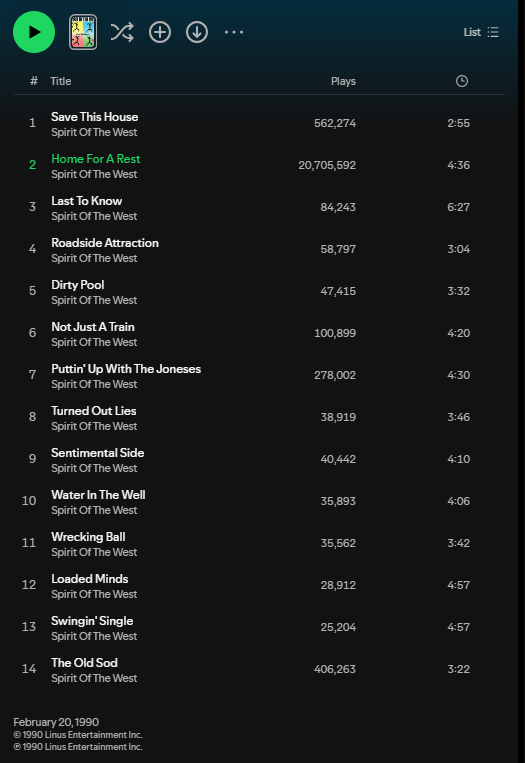
And it almost didn't make it onto the album.
Geoffrey Kelly wrote the lyrics as a poem during the band's first UK tour in 1989. They played four gigs and spent the rest of their time in pubs. He didn't know what to do with it. He didn't play much guitar at the time, so he handed the poem to vocalist John Mann, who put chords to it. When they went into the studio with producer Danny Greenspoon to record Save This House, they didn't even play the song for him. They didn't think it was ready. Greenspoon was about to wrap up and fly home to Toronto when he asked if they had anything else. Only then did they mention it. He recognized its potential immediately. It was recorded as the last song of the sessions.
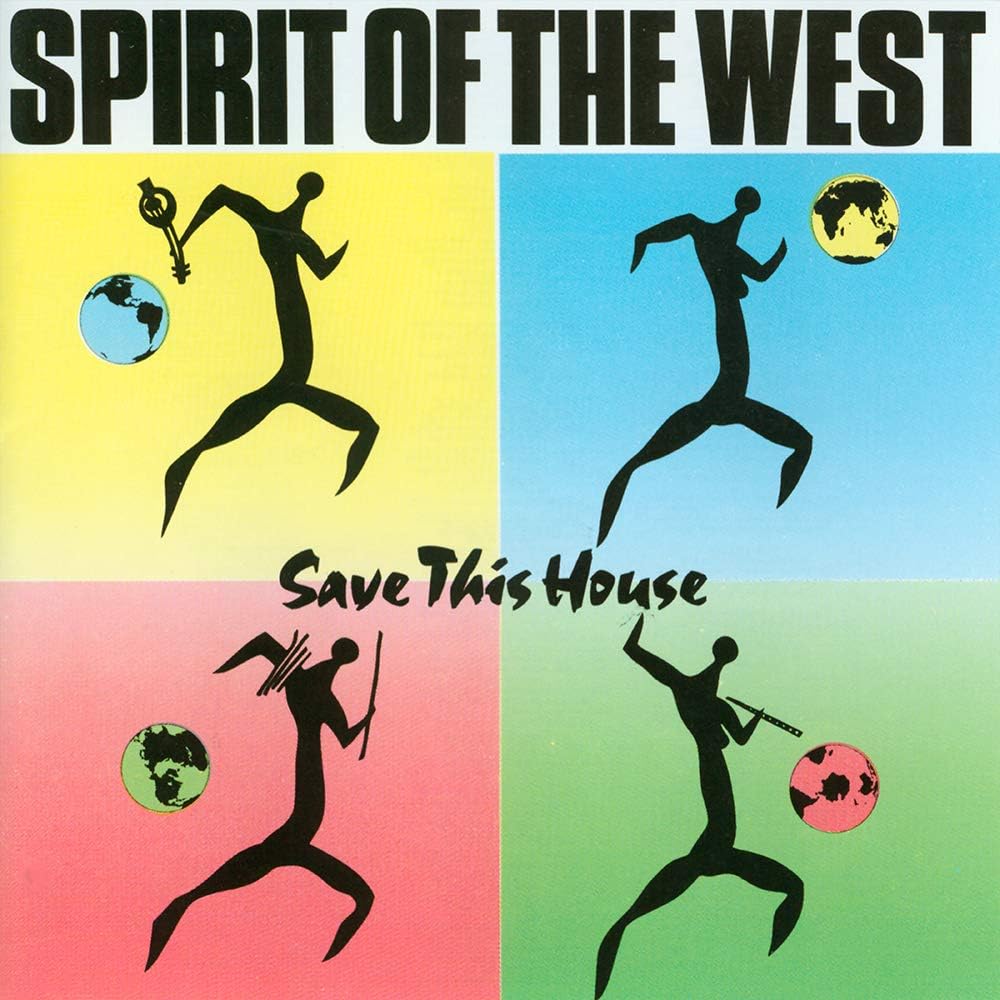
The song was never released as a commercial single. Its rise was entirely organic: MuchMusic airplay, campus radio, word of mouth. It became the standard anthem for frosh weeks, weddings, and pub nights across the country. The Globe and Mail called it "this nation's definitive party song" with "perhaps the most sung-along-to lyric in Canadian music." Kelly himself has said he finds the whole thing baffling: "It is to me still very strange that Canada has really latched on to the song, because the song is really about being in the U.K."
Three Irish Reels in a Rock Song
The instrumental section that closes "Home For A Rest" (the tin whistle passage I transcribed) is built on three traditional Irish reels: "Castle Kelly," "Glass of Beer," and "Swallow's Tail." All three are well-known session tunes, with "Swallow's Tail" dating to at least the 1870s in manuscript form. Kelly embedded centuries-old dance music in a modern rock anthem, connecting generations of tradition to a nationwide singalong.
This matters for understanding the solo. These aren't composed melodies written for a specific recording. They're tunes that have been passed down by ear for generations, played in pubs and at Irish sessions, shaped by the hands (and breath) of countless musicians. They carry a rhythmic, driving energy that comes from their original purpose: making people dance. Kelly's achievement was recognizing that this energy could electrify a rock audience.
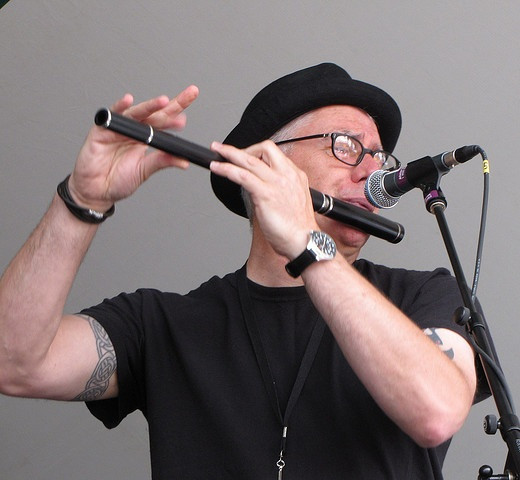
And Kelly himself came to this music late. He was a progressive rock fan through high school (Genesis, Yes, Gentle Giant) with no connection to Celtic music whatsoever. He worked as a heavy-duty mechanic. Everything changed in 1979, when a friend dragged him to a folk club in a small Austrian village to see Scottish singer-songwriter Dougie MacLean. Kelly recalled: "We kind of went to this thing kicking and screaming, but it was probably three or four songs into the show where it just kind of hit me so hard that I was hearing Scottish music presented in a contemporary, cool way." Back in Vancouver, he found his way to an Irish musicians' gathering at a community centre on Hastings Street, where someone suggested he take up the tin whistle. He learned to play by performing for Irish dancers, watching their feet to keep tempo. That dance-music foundation gave his playing its inherently rhythmic, driving quality.
I resonate with Kelly's trajectory more than I expected. I grew up on progressive metal (Dream Theater, Opeth, David Maxim Micic, TesseracT) and came to Irish traditional music much later in life. There's something about being a prog fan that primes you for Celtic music: the odd meters, the intricate melodic lines, the way both traditions reward obsessive attention to detail. You just don't see the connection until you hear it.
A detail that borders on poetic: Dougie MacLean, the very artist whose performance inspired Kelly to pursue Celtic music, contributed fiddle to Spirit of the West's 1984 self-titled debut album. The circle closed within five years.
Why the Ornaments Are the Whole Point
When I first slowed the solo down, I expected the hard part to be the fast runs. It wasn't. The fast runs were just scales and arpeggios. Once I could hear them clearly, I could find them on the fretboard. The real challenge was the ornamentation: the grace notes, cuts, and taps that give the melody its life.
There's a crucial insight that changed how I thought about this transcription: ornaments in Celtic music are not decorations. They are articulations. This distinction, made clearly by Grey Larsen in The Essential Guide to Irish Flute and Tin Whistle, goes back to the uilleann pipes. On the pipes, air flows continuously from a bellows, so the player can't stop and restart the airstream the way a trumpeter tongues a note or a violinist re-bows. When a piper needs to play two notes of the same pitch in succession, the only option is a fingered articulation to mark where one note ends and the next begins. Those fingered articulations evolved into the ornamental vocabulary of all Irish traditional melody instruments, including the tin whistle.
A cut is performed by briefly lifting a finger above the note being played, creating a momentary upward pitch blip that functions as an attack. A tap (or strike) works in the opposite direction: briefly covering a hole below the note, creating a downward blip. Done correctly, you don't hear separate notes. You hear a crisp, percussive beginning to the main note, almost like a little wobble. A roll combines both: a sequence of three notes at the same pitch, each articulated differently: plain, then cut, then tap. And a crann exists specifically for the lowest note on the instrument, where no tap is possible because there's no hole below; instead, multiple rapid cuts create a spiraling, bubbling effect.
These ornaments aren't optional stylistic choices. Playing a Celtic tune without them sounds bare and non-idiomatic, like speaking in monotone. They provide the rhythmic articulation and expressiveness that dynamics provide in other music. The tin whistle, after all, doesn't offer much dynamic range; you can't easily play louder or softer. The ornaments are the expression.
Translating Breath to String
The closest guitar equivalents to whistle ornaments are hammer-ons (for taps), pull-offs (for cuts), and slides. The translation works surprisingly well in practice, but there's one fundamental difference worth understanding.
On a tin whistle, ornaments happen within a continuous stream of breath. The parent note is just as loud after the ornament as before. The sound never stops. On guitar, notes decay from the moment of attack. The default dynamic is different: on whistle, the ornament is a brief interruption in a sustained sound; on guitar, the pick attack is the loudest moment and everything after it is quieter. You can compensate. You can absolutely pick softly and then hammer-on or pull-off aggressively so that the ornamental note is as loud or louder than the picked note, but it requires conscious technique rather than happening naturally as it does on a wind instrument.
There's also a curious physical detail that I find fascinating. On a whistle, a cut involves lifting a finger, which momentarily raises the pitch (by opening a hole above the sounding note). On guitar, a pull-off also involves lifting a finger, but the pitch goes down to the note fretted underneath. Same physical gesture, opposite pitch direction. It's the kind of thing that tickles you neurologically. A tin whistle player and a guitarist performing the same musical effect are making essentially mirror-image movements at the motor level. This would be true of any fipple flute, and likely wooden flutes as well, since they share the same fingering system. It doesn't make the translation harder or easier in any practical sense, but it's a reminder that instruments encode the same musical ideas in fundamentally different physical languages.
Tony McManus, whom John Renbourn called "the best Celtic guitarist in the world," grew up playing fiddle, whistle, and mandolin before guitar. He describes his ornamental technique as "tickling the string" with quick hammer-on/pull-off combinations. His approach captures something important: the goal isn't to replicate whistle ornaments literally. It's to capture their rhythmic function, their role as pulse-drivers and groove-makers. As a contributor on The Session, the major Irish traditional music forum, put it: "As a fairly new instrument to Irish trad, particularly as a melody instrument, I don't think there is really any established system of ornamentation for guitar." The guitar arrived in Irish traditional music only recently. There's no centuries-old codified system, so players adapt and invent.
The Process: Breaking It Down
Mapping the Solo
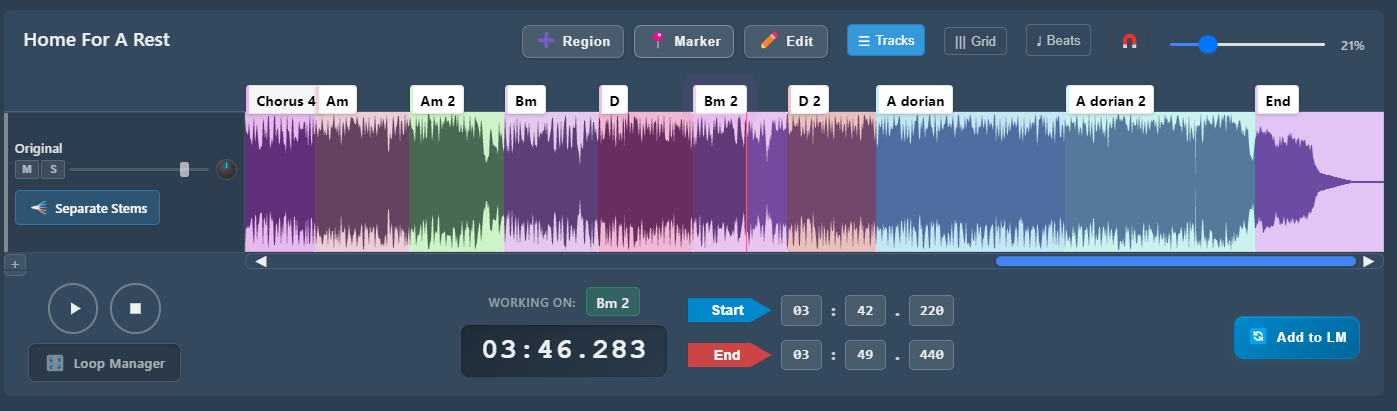
The full solo is over a minute long, which is too much to tackle at once. I loaded the track into PracticeSession, listened through the solo, and dropped a marker wherever I heard a new section begin: each reel, and the distinct phrases within them. Then I converted the markers into loopable regions and organized them into a region group. This gave me an organized workspace where I could jump to any section, loop it, and focus on just that part.
Slowing Down
Some parts of the solo are extremely fast: flights of notes in sixteenth-note triplets at 133 BPM. At that speed, my ears couldn't separate individual notes. They blurred together into a single gesture.
Slowing the audio down to 20% changed everything. At one-fifth speed, each note became distinct. I could hear the pitch, the rhythm, the ornamental flickers between notes. What had sounded like an impossibly fast blur became a clear sequence of identifiable notes that I could find on the fretboard, one at a time.
Slowing down was especially important for the grace notes. At full speed, you hear their effect, that lively, dancing quality, but you can't tell exactly what's happening. At 20%, the ornaments became visible: a higher note falling rapidly into the main note, like a very fast pull-off. Without slowing down, I would have transcribed the melody but missed the ornamental details that make it sound like Kelly's playing and not just a sequence of scale notes.
Speed Training
Once I could play a section reliably at a slow tempo, I needed to bring it back up to speed. I used PracticeSession's speed trainer, starting at 40% and increasing by 5 BPM after every loop.
Each increment is small enough that your muscles adapt without you having to consciously push harder. Over the course of many loops, you go from crawling to running without ever hitting a wall. The key is that each step feels barely different from the last, but after twenty minutes, you're playing at full tempo and it feels natural rather than frantic.
Chaining the Hard Parts
For the final stretch, I picked three short segments that were still giving me trouble and chained them into a single looping sequence in PracticeSession's Loop Manager. As the loop cycled through the segments, the Notation Manager automatically jumped to the corresponding section of the Guitar Pro tab I had written.
Instead of playing through the whole solo and stumbling at the same three spots every time, I was drilling exactly those spots back to back, reading the notation, hearing the audio, and playing along, completely focused on the parts that needed the most work.
Cross-Instrument Transcription: An Old Tradition
Transcribing music from one instrument to another might sound like a niche activity, but it's one of music's oldest and most productive traditions. Bach arranged his own Violin Partita No. 3 for lute. Franz Liszt transcribed all nine Beethoven symphonies for solo piano. At a time when orchestral performances were rare, his transcriptions were how most people experienced symphonic music. In jazz, guitarists have always looked beyond their own instrument: Joe Pass cited only three guitarists as influences, modeling his playing primarily on horn players and pianists like Dizzy Gillespie, Charlie Parker, and Art Tatum. His style has been described as "hornlike, allowing single-note improvisations to flow like a saxophonist's stream of consciousness." Jeff Beck performed Puccini's "Nessun Dorma" and Mahler on electric guitar, producing what one reviewer called sounds that rivaled the human voice.
The value of this kind of work goes beyond the finished product. Pat Metheny has said of transcription: "It is a way to kind of momentarily step into the mind of a great musician and look at the kind of thinking processes that they employ." And saxophonist Mark Turner captures the deeper truth: "You find something you really enjoy... one way to do it is to figure out what do they actually play and feel what it feels like to play like them. So you really get a taste of the master taking you by the hand saying 'This is how you play music.'"
That's exactly what this felt like. Spending hours inside Kelly's phrasing, hearing every ornament at one-fifth speed, trying to find the guitar equivalent of each tin whistle gesture. It taught me things about rhythm, articulation, and Celtic ornamentation that I couldn't have learned any other way. The finished transcription matters, but the process is where the real learning happened.
Download the Tab
I wrote out the full guitar tab for the solo in Guitar Pro as I worked through the transcription. It includes all three reels (Castle Kelly, Glass of Beer, and Swallow's Tail). Rather than using standard grace note notation, which would leave the guitar interpretation ambiguous, I wrote the ornaments directly as pull-offs and hammer-ons, so the tab tells you exactly what to do with your fretting hand.
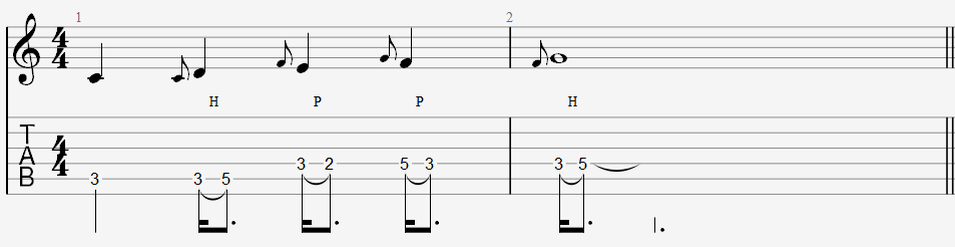
Three downloads are available:
- Guitar Pro file (.gp): the raw tab, compatible with Guitar Pro, TuxGuitar, and other tablature editors. In PracticeSession, you can import this through the Notation Manager.
- PracticeSession notation file: the tab with sync points already mapped, so the notation stays aligned to the audio as you loop and change tempo. Import it through the Notation Manager.
- Full PracticeSession song data: my complete setup, including the notation, all the regions, and the Loop Manager presets I used for speed training and chained practice. To use this, first import your own copy of the audio file into PracticeSession (I can't distribute the song itself for copyright reasons), then right-click the song in your music library and choose "Import Song Data." You'll have the same workspace I used to learn the solo.
From there, use the same approach I described above: slow it down, loop the sections, and build speed gradually.
Learn Any Solo by Ear
PracticeSession lets you slow down any song without changing pitch, loop specific sections, sync notation to audio, and build speed with automatic tempo training.
Download Free TrialWhat the Whistle Teaches the Guitar
Kelly was a prog-rock fan who wandered into a folk club at 22 and had his world changed. He learned whistle by ear in a community centre, developed his rhythmic sense by watching dancers' feet, and wrote "Home For A Rest" as a poem he didn't know what to do with. The song almost didn't make the album. It was never a single. Thirty-two years later, it beat "Call Me Maybe" in a popularity contest.
Now that tin whistle solo, played on a six-hole instrument with no keys by a self-taught musician who learned from Irish dancers in Vancouver, gets translated to electric guitar, an instrument that arrived in Celtic music only recently and has no established ornamentation system. Every cut becomes a pull-off. Every tap becomes a hammer-on. The continuous breath becomes silence between pick attacks. The translation is imperfect, as all translations are. But as Andrés Segovia said of the great guitar transcriber Francisco Tárrega: the art is finding "the same equivalents as would a great poet in translating from one language to another the poesy of another great poet."
References
- Geoffrey Kelly, interview. CBC Radio, As It Happens.
- Geoffrey Kelly, interview. Roots Music Canada, 2025.
- "Home For A Rest." Canadian Songwriters Hall of Fame, 2018.
- 50 Tracks. CBC Radio One, 2005.
- McElroy, Justin. "BC's Favourite Song." CBC, 2022.
- "Home For A Rest." The Globe and Mail.
- Spirit of the West. Save This House [CD liner notes]. Warner Music Canada, 1990.
- Larsen, Grey. The Essential Guide to Irish Flute and Tin Whistle. Mel Bay Publications, 2003.
- "Ornamentation on guitar." The Session (thesession.org).
- Marshall, Wolf. Joe Pass: Virtuoso Standards. Hal Leonard.
- Metheny, Pat. "On Transcription." patmetheny.com.
- Turner, Mark, interview. On transcription and learning from recordings.
- Segovia, Andrés, on Francisco Tárrega's transcriptions.